Best Uses: Matching a Folding E-Bike to Your Actual Route
The eight bikes on this site aren’t interchangeable, even though they’re all “folding e-bikes.” The right one depends far more on what you actually do with it week to week than on any single spec. This page walks through the real ways people use a folding e-bike in the UK — commuting, weekend rides, off-road and mixed terrain, and carrying more than just yourself — so you can match the bike to the route instead of the other way round.
Commuting: the single biggest reason people buy one
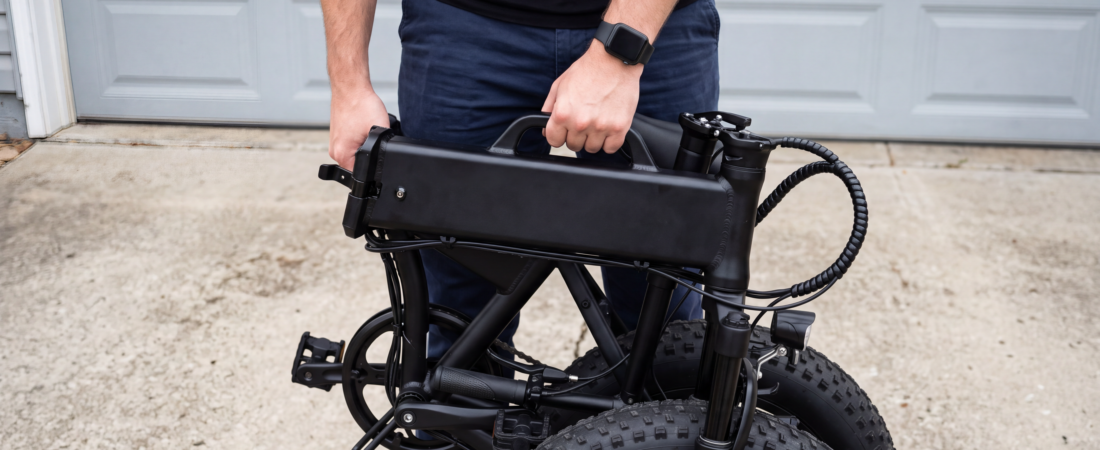
Commuting is, by a wide margin, the most common real reason someone searches for a folding e-bike in the UK — “folding bike commute,” “folding bike commuter” and “folding bike for commuting” all carry consistent volume across Google, Bing and YouTube, and “folding bike commuter” alone is one of the higher-intent searches on TikTok. If your day is a fixed door-to-door route, or a mixed trip that includes a train or bus leg, three things matter more than anything else on a spec sheet: how small and light the actual fold is, whether the range comfortably covers your round trip with a margin for a bad day, and how the bike rides on whatever surface your specific route actually has. If a train or bus is part of your commute, our Folding Bike Storage Bag guide covers what changes once the bike is bagged for that leg of the journey.
The Cycle to Work scheme: a real way to cut the cost
If you’re commuting and buying through an employer in the UK, it’s worth checking whether your workplace runs the government’s Cycle to Work scheme, which lets employees get a bike — including certain e-bikes — through a tax-free salary sacrifice arrangement. Search volume for this specifically is low, but the buyer behind it is a decided one: someone who has already chosen to commute by bike and is now working out how to pay for it. Scheme rules, provider lists and eligible price caps are set by GOV.UK and by your employer, not by us, so check current terms there before assuming a specific bike qualifies.
Weekend rides and longer tours
Weekend and touring riders ask a different question than commuters do. Commuting rewards a bike that folds and stows fast, several times a day. Weekend rides — towpaths, coastal paths, longer loops — reward range and ride comfort instead, since you’re not folding and unfolding six times in an afternoon. If your primary use case is weekend leisure with commuting as an occasional bonus, don’t let fold speed or folded size dominate the decision — that trade-off is optimised for a different rider than you.
Off-road and mixed terrain
Off-road and gravel-specific searches are a smaller slice of demand than commuting, but they’re consistent across Google and YouTube rather than a one-off spike, and they point to a real, specific rider: someone who wants a folding e-bike that can handle towpaths, canal paths, farm tracks or light trail riding, not just tarmac. This is a narrower use case than commuting or touring, and not every bike on this site is built for it the off road pick is the one built specifically around fatter tyres and suspension for exactly this kind of terrain. Don’t assume “e-bike” alone means off-road capable; check the tyre width and suspension on the model’s own page before planning anything rougher than a canal path.
Carrying more than yourself: kids, dogs and cargo
A smaller but real group of buyers isn’t just moving themselves — they’re using the bike to tow a trailer for kids, a dog, or shopping and errands. This is a genuinely different use case from solo commuting, and it changes what matters: trailer hitch compatibility, a motor with enough torque to pull real weight, and stability at low speed matter more here than folded size or top speed. If this is your primary use, treat it as its own checklist rather than assuming any of our eight bikes was designed around towing — check a specific model’s manufacturer documentation for trailer compatibility before buying one for this purpose, since it isn’t something we’ve confirmed bike-by-bike.
Why efoldbike.co.uk Exists: The 10 Problems We Actually Solve
Every guide, comparison and quiz on this site exists to answer one of ten specific problems that actually stop someone from buying or enjoying a folding e-bike in the UK. Not generic content, not spec sheets for their own sake — a real problem, matched to a real answer, backed by what people are actually searching for. Here’s the full list, in one place, and why each problem gets the specific answer it gets rather than a different one.
| # | Real problem | Solution on your site | Why this solution (and not another) |
|---|---|---|---|
| 1 | Doesn’t know which bike to buy — decision paralysis | The 8-bike comparison plus the Find Your Fold quiz that ends in a single recommendation | The single highest-volume term in the whole niche is generic (“best folding electric bike”), not brand-specific — people aren’t searching for a bike, they’re searching for someone to narrow the field for them. A quiz that ends in one result does exactly that; a list of eight unfiltered reviews doesn’t solve that problem, it makes it worse. |
| 2 | Assumes a good folding e-bike always costs a lot | The block of 5 budget alternatives (HillMiles, URLIFE, Finbike U4, ECOSMO, SAMEBIKE) that replaced Decathlon | Four separate “cheap/budget” search variants carry real volume, and none were covered on the site with concrete Amazon options until now. The fix isn’t cutting the price of Brompton, Tern or Dahon — it’s showing that honest options exist below them, with their trade-offs (support, battery, warranty) spelled out rather than hidden. |
| 3 | Has nowhere to store it and no easy way to carry it when not riding | The Folding Bike Storage Bag page — no lock left outside, no shed needed, easier train and bus travel | This problem carries the highest CPC in the whole niche (US$4.26) against generic “bag” variants (US$0.45) — that’s genuine purchase intent, not idle curiosity. It’s backed by consistent demand across five separate platforms, not a spike on just one. |
| 4 | Worried it’s too heavy to carry (stairs, onto a train, up onto a bus) | Weight and folded size highlighted on every bike’s page, pointing to the compact pick whenever weight is the deciding factor | “Lightweight” volume is consistent and high across several variants — a distinct worry from “cheap”, so it needs its own answer rather than being folded into the price problem. |
| 5 | Not sure it will actually fit them — tall, heavy, or larger build | A recommended-height and max-load table on every bike’s page, marked “not confirmed” wherever the manufacturer doesn’t publish it | The CPC on this term is high for a low volume — a classic sign of a specific, decided buyer rather than general browsing, so it’s worth a direct answer even though few people search it. |
| 6 | Afraid it’ll get stolen if left locked on the street | Pair the “fold it and bring it in with you” message with a short lock guide for whenever it does have to stay outside | The related “lockers” search carries one of the highest CPCs in the niche on very few searches — real willingness to pay for a fix, but the root problem is better solved by avoiding it than by competing on lock keywords. |
| 7 | Isn’t sure a folding bike is even the right category for them | Content on About Us and Find Your Fold explaining when a folder genuinely suits someone and when it doesn’t | A buyer earlier in the funnel than the other problems on this list — worth catching before they land on a competitor’s site instead, even though the volume here is modest. |
| 8 | Worried the fold itself will be fiddly, slow, or will break with use | A short video or GIF of the actual fold for each bike, plus the hinge and quick-release type stated in the spec table | Nobody buys a “folding” bike without wondering whether the fold itself will be a headache — the kind of doubt a moving image settles better than a paragraph of text. |
| 9 | Wants to use it for the commute — train or bus — without it being a hassle | Multi-modal commute content folded into the storage-bag page, with a clear note that operator policies vary | Commuting demand is real, but the train and bus detail specifically is a supporting point, not the main hook — so it lives inside the storage-bag page rather than getting its own. |
| 10 | Worried about being left without spares or support after buying an unfamiliar brand | An explicit “what buying without a physical shop actually means” section on every budget bike’s page | Almost nobody searches this directly — they don’t know it’s a problem until after buying. It’s answered anyway because it’s a real risk the reviews already surfaced, and hiding it would be less honest than the site’s own standard. |
Not sure where to start? Take the Find Your Fold quiz and get matched to a bike based on your own answers, browse every model’s real specs and reviews on RideCheck, or see the full side-by-side comparison of all eight bikes.